
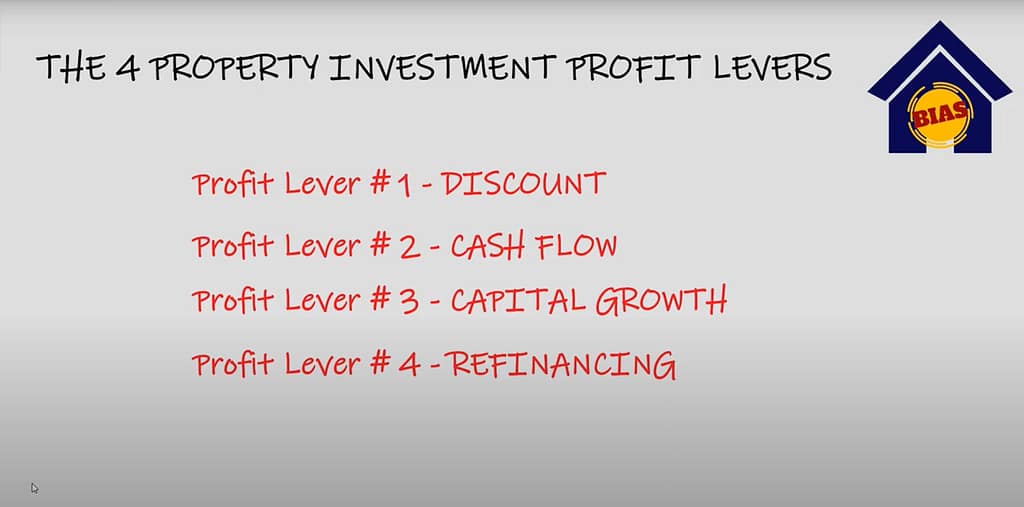
The 4 Property Investment Profit Levers
When looking for a viable and lucrative Property Investment Opportunity there are four main income drivers to consider. We know these as the 4 PROFIT LEVERS.
Our 20 minute video explains the levers fully but if you prefer reading to viewing then we have also summarised them below.
1 – Discount
When you purchase a property at below market value (BMV) for whatever reason, the discount received becomes your immediate equity on completion. This equity can be released as profit if you then sell the property on at its true open market value (OMV); or it may be sufficient to allow you to take part or all of your invested capital out on early refinancing; or as has been the case in current (2022) market conditions it provides a significant step towards shortening the time for capital growth to enable eventual refinancing.
This profit lever may be available when you are looking at a property where you can add value to a property by for instance refurbishment or planning gain; or it may be available when the vendor has a strong motivation to sell quickly.
Discount only pays out once, and is not normally essential for viability although there are still some investors who insist on only buying BMV.
2 – Cash Flow
Positive cash flow is the lifeblood of a property deal and is thus essential.
Your cash flow is the money left over from your rental income after all expenses have been paid.
If cash flow is negative or non-existent then you will have to bear all expenses out of your own pocket which defeats the object of investing in the first place. Insufficient cash flow will also make it far more difficult to find a lender when it comes to refinancing.
However, there may be rare situations where a sophisticated investor is prepared and able to carry those costs in anticipation of better than average capital growth.
Positive cash flow pays out continually giving a passive (or nearly passive) income stream for as long as the property is owned and rented out. It is normally a pre-requisite for lenders when it comes to refinancing.
3 – Capital Growth
As discussed in a previous post house values have on average doubled every 10 years since the late 1800s. All this growth belongs to you thus reliably increasing your net worth and creating true wealth.
Just be aware though that this is not the same as income – in order to place that equity growth in your pocket you will have to sell or refinance.
Capital growth again is continuous in the long term.
4 – Refinancing
Refinancing is how we take (some of) our equity growth out of our asset and into our pockets. Although we may think of this money as “income”, since we have borrowed it against the new value of our asset it is in fact a loan requiring eventual repayment and is to all intents and purposes ours to use as we wish.
You can decide to splash out on a new car; a world cruise; improvements to your residence – all without Income Tax implications.
But the prudent investor is more likely to reinvest at least part of the refinancing proceeds as deposits on new properties to continue building a portfolio. This how real wealth is accumulated from property investment activities.
It is important to remember that any lender will want to see evidence of sufficient cash flow to cover the increased lending.
Just to touch on the comment above regarding “requiring eventual repayment” – this will be covered by future refinancing as the asset value continues to increase.
What Next?
If you are excited by the possibility of making your savings work harder for you, especially in this period of higher inflation, where savings value is being eroded daily, then why not book a friendly no obligation chat with us to see which options could be open to you. Just click the button below to set up a no obligation introductory Zoom call.